

Types of gates in injection molding vary in where the plastic enters the cavity and in how the gate separates from the part. The gate controls how the cavity fills, how the part is packed and what mark remains on the surface. Each type suits a defined set of parts and mold layouts. Gate type, location, and size are chosen together during mold design to suit the resin and the surface of the part.
What Is a Gate in Injection Molding?
A gate is the restricted opening that connects the runner to the mold cavity, the hollow space that forms the part. It must let the cavity fill and pack, and it must allow the runner to separate from the part. Injection molding gate design therefore covers the type, location and size of this opening, and the types of gates in injection molding follow from those three choices.
- Sprue: The channel that carries plastic from the machine nozzle into the mold.
- Runner: The channel that carries plastic from the sprue to each gate.
- Gate: The restricted opening between the runner and the cavity.
- Cold runner and hot runner: A cold runner solidifies with the part and is trimmed off, while a hot runner keeps the plastic molten up to the gate.
Which Types of Gates in Injection Molding Are Trimmed Manually?
Manually trimmed gates leave a connection that is removed after ejection, either by hand or with a trimming tool. Manual trimming is used where automatic removal is impractical for the part.
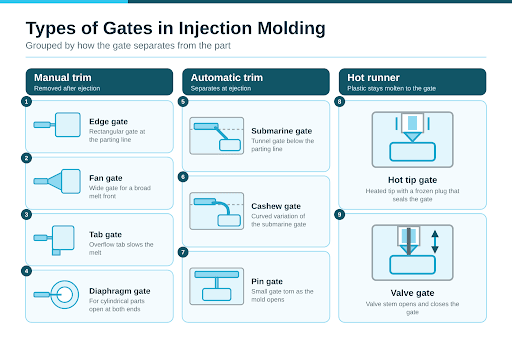
- Edge gate: A rectangular gate attached along the part perimeter at the parting line, the seam where the mold halves meet, and the basic type.
- Fan gate: A gate that widens from the runner toward the cavity to give a broad, uniform melt front, which reduces jetting, a snake-like flow mark, and shear.
- Tab gate: A gate that splits the melt between the gate and an overflow tab, which slows the melt as it enters and reduces jetting.
- Diaphragm gate: A gate for cylindrical parts open at either end, used where concentricity matters.
Which Types of Gates in Injection Molding Are Trimmed Automatically?
Automatically trimmed gates are machined into the mold during injection mold manufacturing and separate from the part when the mold opens or the part is ejected, which removes the need for gate trimming as a secondary operation and minimizes gate scars. Hot runner gates work with plastic that stays molten, and the gate forms at the hot runner tip.
- Submarine gate: A conical gate, also called a tunnel gate, that runs from the runner to the cavity below the parting line and is sheared from the part as the parts and runners are ejected.
- Cashew gate: A curved variation of the submarine gate that reaches areas beyond the range of a straight tunnel gate.
- Pin gate: A small-diameter gate that is torn from the part as the mold parting line opens.
- Hot tip gate: A hot runner gate formed by a heated tip aligned with a funnel-shaped hole, where a frozen plug of plastic seals the gate until injection starts.
- Valve gate: A hot runner gate in which a valve stem moves to open and close the gate mechanically, so the gate does not wait to freeze.
How Do the Gate Types Compare?
Each of the types of gates in injection molding pairs a removal method with a typical use. In plastic injection molding, hot runner gates close at the runner tip, so no separate runner needs removal.
| Gate | Removal | Typical use |
|---|---|---|
| Edge | Manual | Basic gate along the parting line |
| Fan | Manual | Wide parts that need a broad melt front |
| Tab | Manual | Parts where an overflow tab slows the melt |
| Diaphragm | Manual | Cylindrical parts open at both ends |
| Submarine | Automatic, sheared at ejection | Parts that need automatic gate removal |
| Cashew | Automatic, sheared at ejection | Areas beyond a straight tunnel gate |
| Pin | Automatic, torn as the mold opens | Parts that need a small gate and automatic removal |
| Hot tip | Hot runner, frozen plug | Hot runner molds with simple gating |
| Valve | Hot runner, valve stem closes | Parts with strict cosmetic limits |
How Should Gate Location and Size Be Chosen?
Gate location sets where the cavity begins to fill, so it also sets where two streams of plastic meet and weld lines, the visible seams at that meeting point, form. A gate at the thickest area of the part supports filling and packing, and gates belong in non-cosmetic areas whenever possible.
Gate size balances two needs in every one of the types of gates in injection molding. The opening stays small enough for easy removal and large enough to pack the part and control shear.
- Gate vestige: The small mark or bump left on the part where the gate separated.
- Valve gate: Valve gates are typically selected when part cosmetics call for a very small vestige.
- Automatic trimming: Automatically trimmed gates are chosen to minimize gate scars.
- Placement: The gate sits where its mark falls on a non-cosmetic surface.
How Is a Gate Type Selected for a Part?
Applications of the types of gates in injection molding vary with part shape, surface requirements, and production layout. Working through a fixed order of questions during injection mold design narrows the choice.
- Identify the cosmetic surfaces, and place the gate location on a non-cosmetic area.
- Decide the trim method: manual removal, automatic removal, or a hot runner gate.
- Match the part shape, such as a diaphragm gate for a cylinder or a fan gate for a wide part.
- Check the resin, because high glass-fill resins can plug a small gate such as a hot tip gate.
- Set the gate size for packing and easy removal, and confirm the fill with mold flow analysis, a simulation of how plastic fills the cavity.
How Does Radiant Design Support Injection Molding Gate Design?
Gate type, location, and size are fixed in the DFM and mold design service at an injection mold manufacturing company in India before the mold is machined. Injection mold manufacturing then builds the chosen gate and runner into the mold, and injection molding and production run the cycle with them. Together, these services apply the types of gates in injection molding to each part.